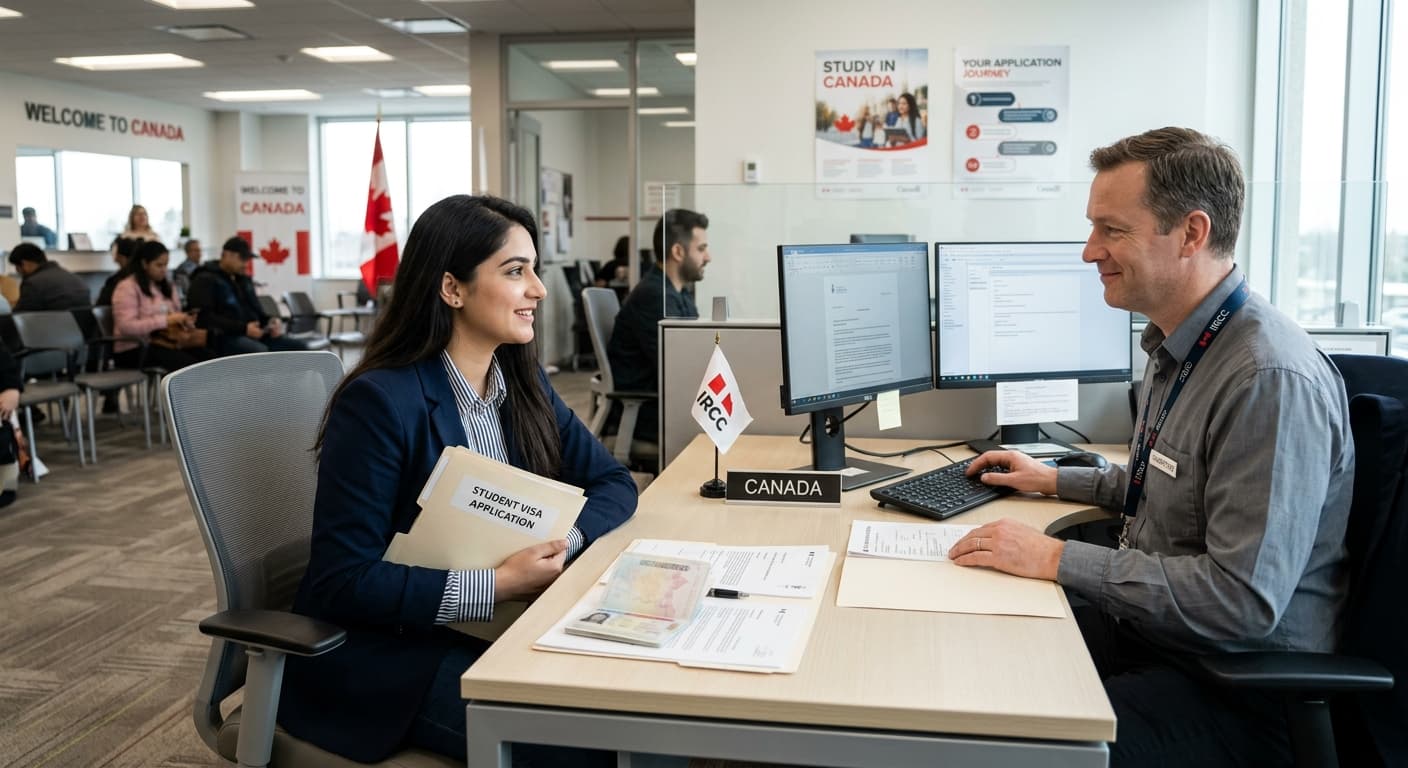
Most people applying for a Canada study permit interview never actually sit through one
Here's something the government pages don't lead with. The majority of Canadian study permits are granted without the applicant needing to attend a visa interview, according to nationwidevisas.com. Your file gets reviewed, your documents get checked against your program and your bank statements, and a decision gets made without anyone ever speaking to you.
But some students get pulled aside. Either before the visa is issued, or later, at the airport, when a border officer has questions before you've even collected your bags. Almost nobody explains what that specific moment looks like, or why it happened to you and not your roommate. That's the part worth actually covering.
Do you actually need a Canada study permit interview?
Probably not. But if you do, it's rarely random. IRCC can instruct applicants to attend an interview with officials, either in their home country or by video, or to submit additional information, according to canada.ca. The trigger is almost always something in the file that doesn't add up cleanly.
What actually pulls a file into interview review
A sudden, unexplained career pivot, like an applicant with five years in accounting applying to a diploma in culinary arts with no bridge in between.
A multi-year gap in your education or employment history with no letter accounting for it.
Financial documents that were opened or funded within days of the application, rather than months.
A study plan that doesn't logically follow from your prior qualifications, or a program that seems mismatched to your stated career goal.
A previous refusal on your file, for a study permit, visitor visa, or otherwise.
None of these guarantee an interview, and none of them guarantee a refusal either. They just move your file from the pile that gets approved automatically to the pile a human reads twice.
Where it happens, and whether you'll ever leave your bedroom
This is the part the big guides skip entirely. If IRCC calls you in, it's usually one of two formats: an in-person interview at a Visa Application Centre or embassy, or increasingly, a video call through the same portal you used to apply. Which one you get depends on the country you're applying from and how the local visa office is set up that year, not on anything you did wrong.
If this is your first time reading an interview letter and you're not sure whether it's asking for a document or an actual appearance, that ambiguity is exactly the kind of thing worth getting a second opinion on before you respond. It's one of the reasons some applicants choose to work with someone who reads these letters professionally, covered in 5 Reasons to Hire a Visa Consultant Instead of Doing a DIY Application, instead of guessing.
What they actually ask you
The questions repeat across almost every case: why this program, why this school, who's paying, and what you plan to do afterward. Officers want short, specific answers, not a rehearsed speech. If your funding is a combination of a parent's salary and a sponsor's savings account, say that plainly instead of a vague "family support."
If you applied to more than one country and you're still weighing where to land, it's worth knowing that study in the UK carries a high visa success ratio as well, and that IELTS isn't always required there either. For question-by-question practice that goes beyond what's specific to Canada, the patterns covered in Top Student Visa Interview Questions and Answers You Must Prepare For repeat across most visa systems, not just this one.
Dual intent is the part people overthink
You're allowed to want to study in Canada and also hope to stay after, through a post-graduation work permit and maybe permanent residence down the line. That's not a contradiction officers are trying to catch you in. Handling dual intent inside a Canada study permit interview just means saying both things out loud, clearly, without pretending you have no interest in what comes next.
What sinks people isn't having long-term plans. It's dodging the question, or insisting you'll definitely leave the moment your diploma is printed, which nobody believes and nobody needs to hear.
The other interview nobody warns you about: CBSA at the airport
This is the one almost every arriving student actually goes through, and it isn't the same thing as the IRCC pre-approval interview at all. At Canadian airports, the port-of-entry interview happens before you can even pick up your luggage, according to applyboard.com. A CBSA officer checks your paperwork, asks a few quick questions, and either lets you through or sends you to secondary examination.
Pre-approval interview versus the airport check
Aspect | IRCC pre-approval interview | CBSA port-of-entry check |
|---|---|---|
When | Before your visa is issued | The moment you land |
Who conducts it | Visa officer, in-person or by video | Border services officer, in person |
What's decided | Whether your permit is approved | Whether you're admitted to enter |
Typical length | 15 to 30 minutes | A few minutes, longer if flagged |
Both are technically a Canada study permit interview in the broad sense, but only the first one decides whether you get the permit at all. The second one decides whether the permit you already have actually gets you in the door.
What to physically carry with you
Keep this in your carry-on, never checked baggage:
Your passport and the letter of introduction IRCC emailed you.
Your provincial attestation letter, if your province requires one.
Your letter of acceptance from the school.
Proof of funds, even if you already showed this during the application.
Housing confirmation for at least your first few weeks, if you have it.
Officers have seen every version of a nervous student fumbling through a phone for a PDF. Print copies save time, and time is exactly what's short at a busy arrivals hall.
If the questioning gets intense, or you get refused
Secondary examination sounds worse than it usually is. You get moved to a separate room, a different officer reviews your file, and you may wait an hour or more. Answer consistently with what you told the first officer. If you're refused entry outright, ask for the decision in writing and note the officer's name, because that's what you'll need if you pursue any recourse afterward. This is the part almost no guide covers in detail, and it's also the part students remember most clearly years later.
Once you're in and settled, the practical rules kick in fast. Eligible students with a valid study permit can work off-campus up to 24 hours per week during academic terms, according to cicnews.com, with no such cap during scheduled breaks.
Most students reading this will never sit through any version of a Canada study permit interview at all, and that's the honest, slightly anticlimactic truth of it. But if your letter arrives with an interview request attached, that's not a signal your application is in trouble. It's a signal someone's actually reading it closely, which, if your file is clean, works in your favor more than people assume.
Frequently asked questions
Is an interview mandatory for a Canada study permit application?
No. Most applications are decided on paperwork alone, with no interview at any stage. IRCC only requests one when something in your file needs clarifying, such as inconsistent finances or an unexplained gap in your education.
What questions do CBSA border officers ask international students at the airport?
They ask about your program, your school, how long you're staying, and how you're funding it. They also check that your documents match what's in the system, since this happens before you're even allowed to collect your luggage.
How do you explain dual intent during a Canadian student visa interview?
Say plainly that you plan to study, possibly work after under a post-graduation permit, and that none of that guarantees permanent residence. Officers aren't testing whether you want to stay in Canada eventually. They're testing whether you're being straight about it.
What documents must be carried for the port of entry inspection in Canada?
Bring your passport, your letter of introduction from IRCC, your provincial attestation letter if your province requires one, your acceptance letter, and proof of funds. Keep them in your carry-on, not checked luggage, since you'll need them before baggage claim.
How many hours per week can international students work off-campus in Canada?
Eligible students with a valid study permit can work off-campus up to 24 hours per week during academic terms, according to cicnews.com. There's no cap during scheduled breaks like summer or winter holidays.